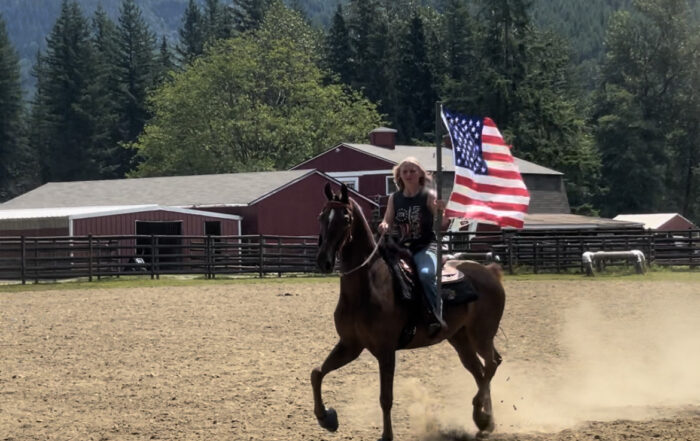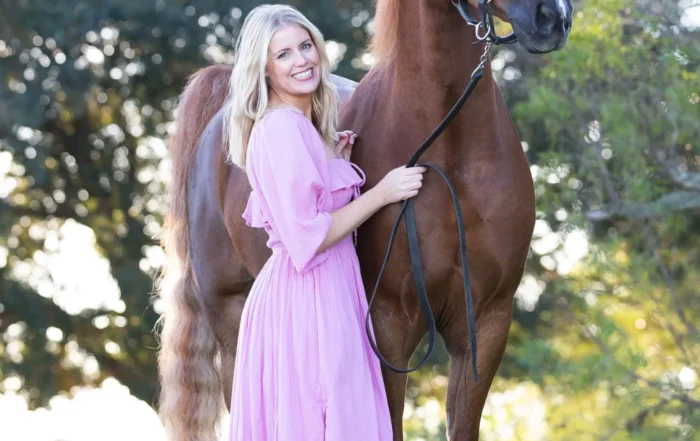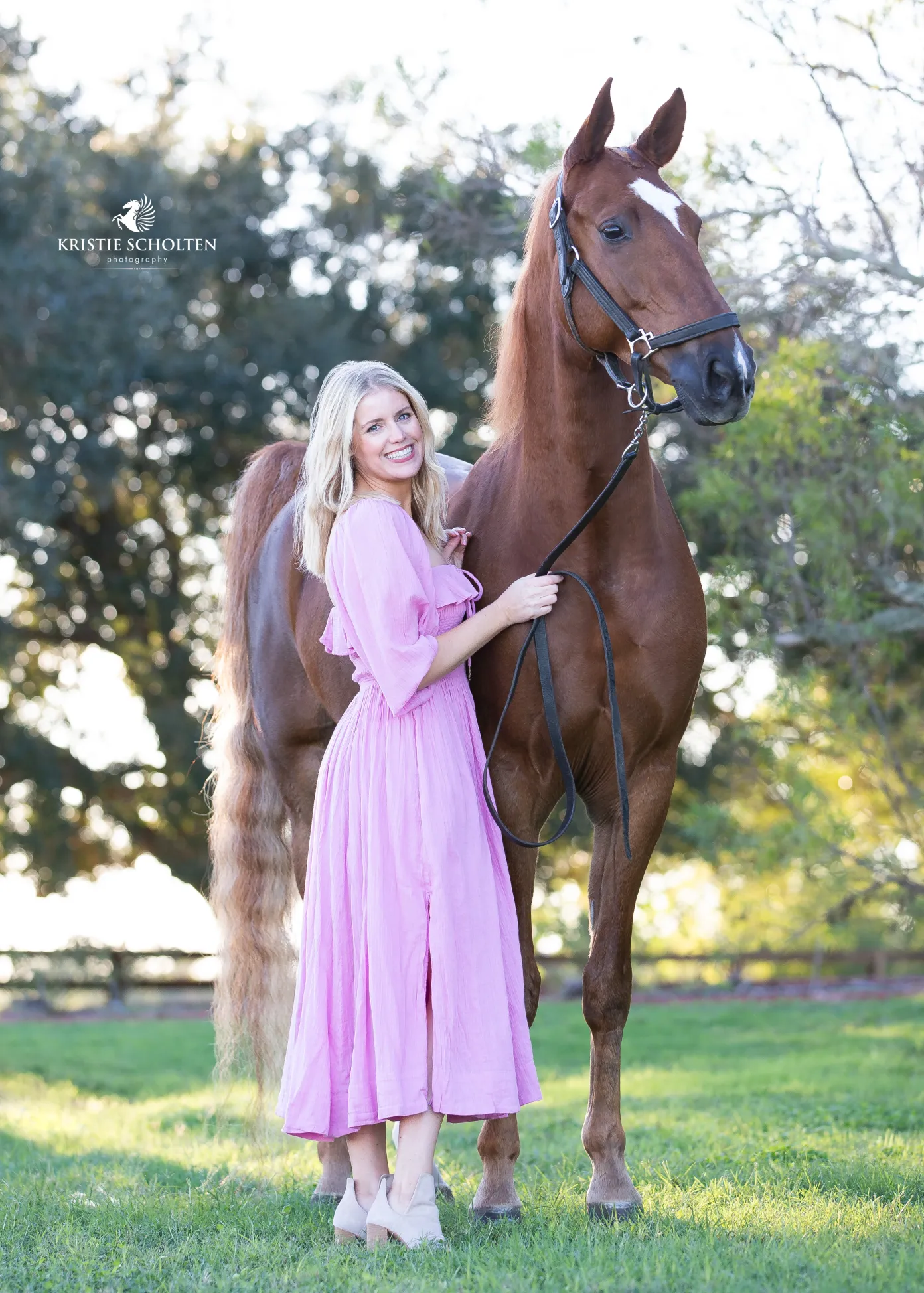
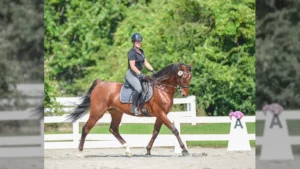
Seven years ago, Mr. GQ was a birthday present for our daughter’s 15th birthday – because every teenage girl needs a Mr. GQ to give all of their attention and love, especially the four-legged kind.
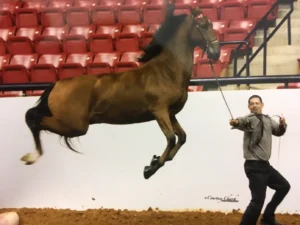
Q was young – seven years old – super spunky, and the perfect partner for our daughter Olivia’s very first five-gaited show pleasure American Saddlebred. When Olivia went off to college at Texas A&M (Gig ‘Em!), Q went with her to Texas. He was born and raised at Bluebonnet Farm, and trainer Sandra Currier was well-acquainted with him. So, to Bluebonnet he returned. During Olivia’s freshman year of college, she continued to ride and show Mr. GQ in saddleseat, both five-gaited show pleasure and then three-gaited show pleasure. I also dabbled in showing Mr. GQ saddleseat three-gaited show pleasure while he was in Texas.
Between Olivia’s freshman and sophomore years of college, Mr. GQ came home to our farm, Staymore Farm – home of Warrior Sporthorses – in Folsom, Louisiana. My husband has a saying that “everything on the farm needs to have a purpose or needs to find a new family.”
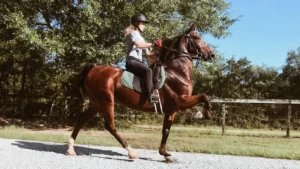
So, with that in mind, I decided to start riding the newly “retired” Mr. GQ. My plan was to have fun and do some all-around sport horse adventures, or at least try. We have some fun local shows that offer low-stress combined tests, just jumpers, and dressage-only classes that would be a good start to our sport horse adventures.
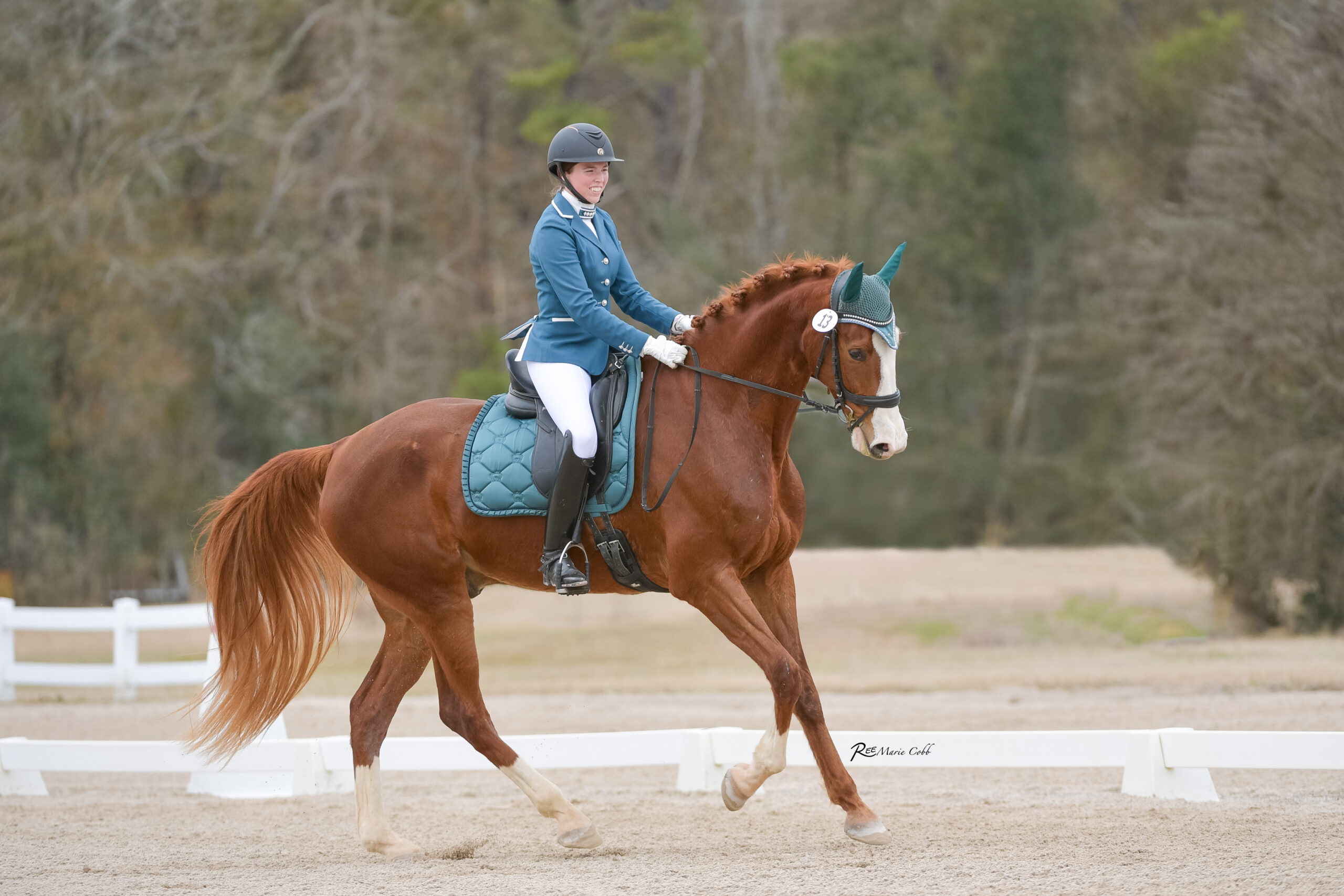
The Pre-Mini Amoeba division, the beginner class for horse or rider, consists of an Introductory Level dressage test and a “jump” course that is literally poles on the ground. I figured that, if nothing else, we could walk over the poles. Turns out, Mr. GQ loved that division, and we won the overall Year End Champion Adult Amateur through our local club, the Southern Eventing and Dressage Association.
I knew we needed to improve our dressage and start focusing on that aspect of his sport horse training. With the help of a good friend, Isabella, we started working on bettering our dressage skills and working towards small goals. At first, transitions were difficult for him (me too, at times), and going from a trot to a canter and back to a trot was mind-boggling to him. All he has ever known in the saddleseat ring was to canter from the walk and to walk immediately after his canter. It took a full year for him to understand that it’s possible to transition into the canter from the trot.
We spent many shows riding Intro A and B, just walking and trotting, until we finally added an Intro C test to the mix. The next learning block for Q was to understand that he could be round while trotting and still go into the canter round, using his body in ways he never had before. Actually, we both were learning to use our bodies in different ways.
I’ve ridden and shown my entire life, starting at 6 months of age. Yes, my very first lead line class was at 6 months old, and I still have the ribbon. Growing up, I was trained to ride Saddleseat and rode that discipline into adulthood. I started dabbling in dressage very, very loosely more than twenty years ago with my Saddlebred mare, When Pigs Fly.
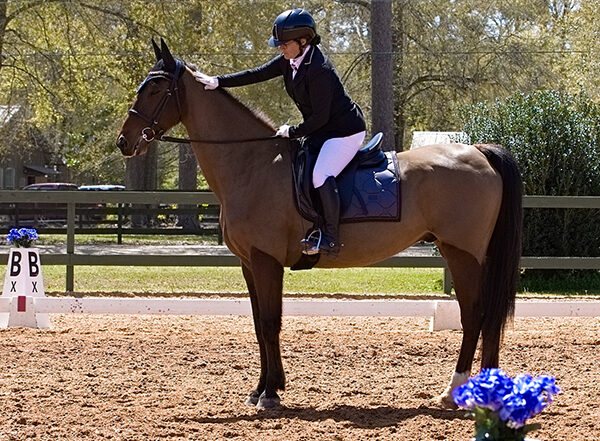
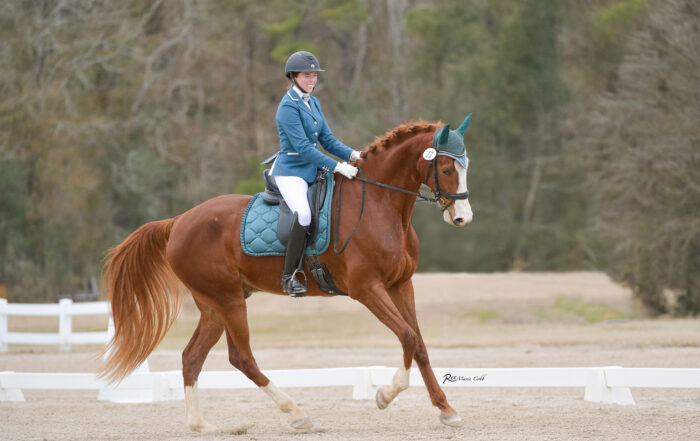
Dressage is a completely different style from saddleseat riding, as I was taught. I’ve become more focused on my dressage journey in the past three to four years, learning to release my legs, use every part of my legs in a separate and relaxed manner, that my pelvis tilt means more than I ever thought it did before, and that I need to have much more flexibility. Each ride, I learn more and more about the body positions of both me and my horse. GQ and I continue to work on our transitions to canter, but it is getting better and better with each ride and each transition.
One of our biggest accomplishments so far is attending the Abi Lyle Clinic – we rode with an Olympian!
A little backstory on why this was a huge accomplishment for us, or me, mainly: The weekend before the clinic, we had attended a dressage show, and it had not gone as I would have liked, score-wise. Yes, I know that scores are not everything; however, GQ was a good boy, had done everything asked of him, and we were much improved from six months prior. I was proud of my horse, but seriously disappointed with our scores, and wondering if I should even continue on this path.
On the drive home, I thought about selling the clinic spots to someone else and calling it quits. It was a struggle, and those who know me know I don’t quit, or even think about it, but I was at that point. I decided to sleep on everything and figure it out in the next few days, once the emotions had passed. Attending the clinic turned out to be one of the best decisions I’ve made for us.
Abi had never worked with an American Saddlebred, so Mr. GQ was her very first! GQ and I learned so many things during our two days, one of the most important being that he is capable of doing what I’m asking him to do in the dressage world; that we can communicate, and I can ask him and if he doesn’t answer, I can ask again, perhaps quicker, and that he can impress an Olympic rider, who was very complimentary of him and the American Saddlebred breed.
Our goal going forward is to continue growing and improving. I think qualifying for the Great American/USDF Regional Dressage Championships would be fun, but I know we have lots to practice before that becomes a reality. We have been showing Training Level Test 3, which he has completely memorized because he is a Saddlebred – they are super smart and excel at memorizing repeated patterns. This is a challenging test for us. For years, GQ entered the show ring to the left, walked, trotted, slow gaited, racked, cantered, then reversed direction to the right and did it all again. Then, to end the class, he would be asked to trot around into the lineup in the center of the arena.
Why does that matter? Well, in Training Level Test 3, the last sequence of movements is “Between A and K working canter right lead; E circle right 20m; C working trot; B circle right 20m allowing the horse to stretch forward and downward.” As we are circling, Mr. GQ thinks “E” means “End,” so he wants to line up and park out. I get a giggle now when I feel him think about stopping to line up, and part of me says to him through my body, “Nah buddy, we still have the rest of the stretchy circle, and then down centerline for the halt and salute.”
Our partnership has grown tremendously. To be honest, I was not a fan of riding Mr. GQ when he came home from Texas. I mean, he’s not my horse, he’s my daughter’s horse, and they got along great. He’s quirky, opinionated, and still spunky at times. However, over the past three years, Mr. GQ has grown into my heart; he’s taken a part of it and molded himself into that piece that fits perfectly when we know we love a horse and have bonded. We have accomplished many things together, from big-time dressage shows at the World Equestrian Center to trail rides on the farm. He is a goofball with a sissy whinny when he nickers.
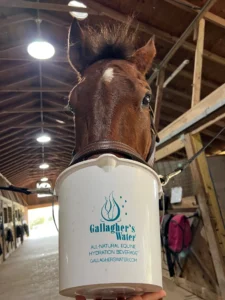
When he came home, he couldn’t go out if there was any rain; he didn’t know that horses could actually get wet from the sky and would get upset. He’s been a show horse since he was a baby, so the joke around our farm is that he doesn’t know how to be a horse. He only likes warm baths. His favorite drink of all time is Gallagher’s Water. When he sees it being prepared, he starts his “G Water dance” in the crossties, sissy whinnies, starts kicking out, and then, once he gets the bucket, he downs it like a college frat boy at a kegger. He actually won a Gallagher Water drinking contest at a horse show!
I can’t imagine life without Mr. GQ in it. He does what he’s asked, always has a good time, and he’s helping make me into a better rider by building my confidence with each and every ride. He has become a significant part of my life now, and I enjoy every minute with him. Mr. GQ may not be the first Saddlebred that I have participated in dressage with, but he is the one I’ve gone the furthest with so far. It’s a huge accomplishment for me to take a horse who is now fourteen, originally trained in a completely different discipline, and transition him to his new discipline.
His saddleseat trainer, Sandra, did an outstanding job with all of his primary basics, which has given me a great platform to work off of. With that said, I’m learning that dressage is full of twists and turns, and that it takes a village to accomplish all of it. Consistently taking lessons from great trainers and clinicians helps develop all of the building blocks necessary for this sport, and having the right people around you and your horse is another important aspect.
I really want to thank everyone who has been part of our dressage journey thus far: my husband, who comes to watch at our shows; my mother, who cheers us on; my daughter, who shares her horse with me (and let me trim his long mane so it would be easier to braid); Heather, who keeps him fed and loved; Dr. Allison, his vet, who keeps him healthy; Dr. Bolt, who keeps him adjusted; Erinn, who does his Magnawave; Isabella, who keeps us going; Deanna Meyers for her fantastic lessons and schooling; Cara Blanchard for her virtual lessons; and everyone else that has helped us along this journey so far – your cheering and support means the world to us.
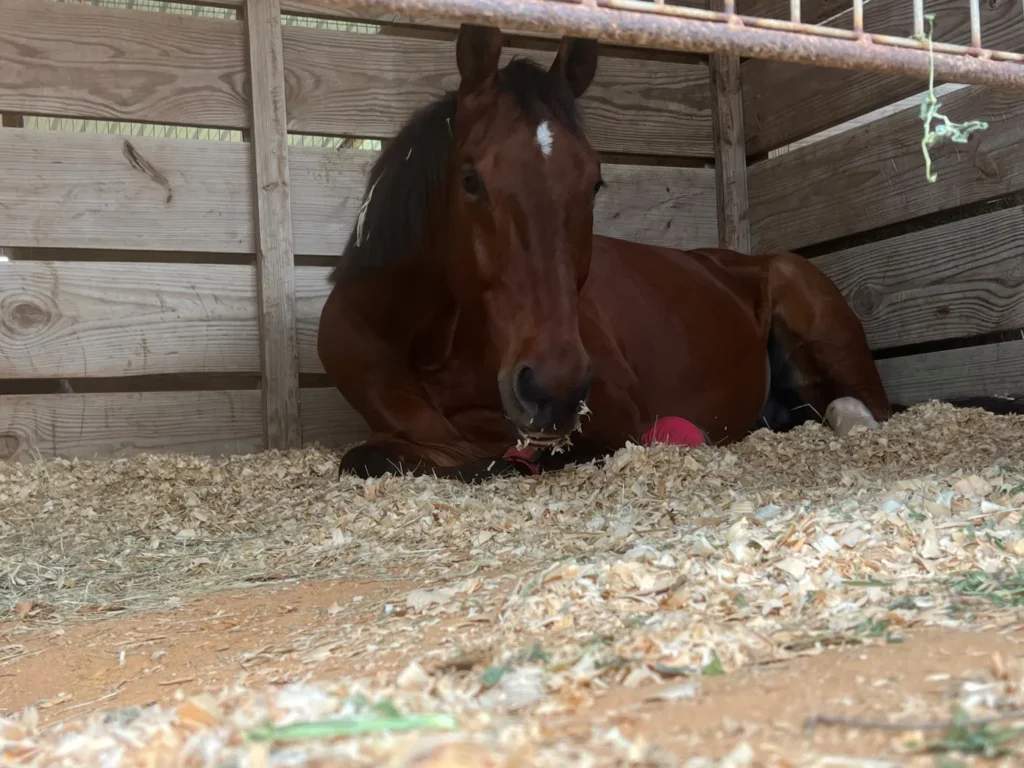 In all of the Saddlebred sport horses that I have worked with, I have found them to be happy, highly intelligent, have a fantastic work ethic, and give you everything you ask for and then some. They are often overlooked for disciplines such as dressage, eventing, and jumping, but honestly, they outshine many other breeds.
I overheard one of my favorite comments on a video of a cross country trip on my Saddlebred mare about eight years ago. Someone standing near the professional videographer said, “Look at that horse’s happy, forward ears… oh wait, that’s the Saddlebred – she’s so HAPPY! She’s beautiful! She is really enjoying herself.” A Saddlebred will steal your heart if you give them the chance, and really, isn’t that what any of us are after – the horse that will walk through fire for us, love us unconditionally, and give us their all, no matter what? That’s the American Saddlebred, and that’s Mr. GQ.